
An important aspect of investment planning is to
assess the impact of taxes on your investment returns, so that you can
make the right investment decision and also file your income tax return
correctly. Investors often tend to ignore the impact of taxes on their
investment planning. Taxes, however, have a significant impact on the
returns earned by the investor and therefore investors should pay due
attention to the tax treatment of their investment returns and plan
their investments accordingly. Mutual funds are amongst the most tax efficient investment options available to investor in India,
compared to a lot of other investment options. If we educate ourselves
on tax impact of mutual fund investments and plan our mutual fund
investments carefully, we will be able to make the most tax efficient
investment decisions.
Before we into the details of mutual fund taxation,
let us recap the exemption limits, income tax slabs and key deductions,
since some important changes were introduced by the Government over the
past 24 months.
Income tax Slabs
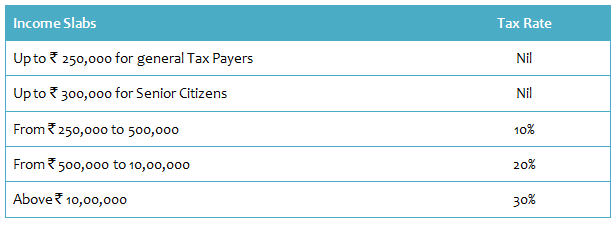
The table below summarizes the income tax rates for individuals and Hindu Undivided Families.
Allowable Deductions
Various deductions are allowed from your gross taxable income under various provisions.
Section 80C:
A deduction ofर1.5 lacs from your gross taxable income is allowed for investments under Section 80C. Among other investment options, you can save taxes under Section 80C by investing in mutual fund Equity Linked Savings Schemes (ELSS).Section 80CCD:
A further deduction ofर50,000, over and above the Section 80C limit ofर1.5 lacs, has been allowed for investment in the National Pension Scheme. Therefore the total deduction allowed under Section 80C and 80CCD is nowर2 lacs.Section D:
Maximum allowable deduction for health insurance or Mediclaim premium under Section 80D has been increased toर25,000 for self, spouse and dependent children. The applicable deduction for senior citizens isर30,000.Section 24:
The maximum deduction on account of interest paid on home loan for a self occupied property has been raised toर2 lacs per annum.Transport Allowance:
Deduction towards Transport Allowance has been increased fromर800 toर1600 per month.
While a number of other changes have also been
introduced, which will discuss in another blog, the Finance Minister
said in his last Budget speech that the total tax benefits available to
individual taxpayer will now be
र4.44 lacs.
As a mutual fund investor, you should remember five important points related to your tax obligation:-
An incidence of taxation arises only when you sell your mutual fund units:
You need to pay taxes only when you sell the units of your mutual fund and you make a profit, subject to mutual fund tax provisions. Incidence of taxation arises whether you redeem your units partially or fully. If you bought 100 units of mutual fund scheme and you sold just 20 units at a profit an incidence of capital gains will arise, as per the mutual fund tax provisions. On the other hand, if you bought 100 units of a mutual fund scheme and you are still holding it, you do not have any obligation to pay taxes if you are still holding all the units.There is no tax deducted at source for mutual fund investors who are residents of India:
If you are a resident of India from a tax jurisdiction perspective, the mutual fund company will not deduct any tax at source (for NRIs it is different, but more about that in a separate post), when you redeem your mutual fund units. However, just because tax is not deducted at source (TDS), it does not relieve you of the obligation to pay taxes on your mutual fund profits. You should declare your mutual fund profits in your income tax returns (ITR), as per the mutual fund tax provisions and pay tax accordingly. Failure to declare your income correctly in your income tax is illegal and may lead to adverse consequences.Mutual fund dividends are tax free in the hands of the investors:
Remember dividends paid by your mutual fund units are tax free in your hands. The mutual fund company may have to dividend distribution taxes, depending on the income tax provisions, but in your hands the dividends are tax free.Mutual Fund switches are subject to tax:
Many investors think that, if instead of booking mutual fund profits, they switch from one scheme to another they will avoid short term capital gains tax. Investors should remember that, from a tax perspective, a switch is treated as a redemption combined with a fresh purchase. For example, if you switched from an equity fund scheme where you made a profit within 1 year from the date of investment to another mutual fund scheme, you will be liable to pay short term capital gains tax.Systematic Transfer Plans (STP) from Liquid Fund to Equity Fund:
If you are making systematic transfers from a lump sum liquid fund investment to an equity fund over a period of time, you will be liable to pay short term capital gains tax on the redemption of liquid fund units for transfer to the equity fund scheme, if the NAVs of the liquid fund units is higher at the time of the transfer than the NAV of the units at the time of purchase.Systematic Investment Plan (SIP) redemptions:
In the case of a SIP, each instalment is treated as a fresh investment from a tax perspective. Therefore, in the case of redemptions from accumulated units through a SIP in an equity mutual fund scheme, the units purchased less than 12 months prior to the date of date of redemption, will be subject to short term capital gains tax. In the case of redemptions from accumulated units through a SIP in a debt mutual fund scheme, the units purchased less than 36 months prior to the date of date of redemption, will be subject to short term capital gains tax. However, in the case of partial redemptions from units accumulated through SIP, the accounting principle of First In - First Out (FIFO) method applies. Therefore, you will be at an advantage, if you have been doing SIPs over a long investment horizon.
For More information CLICK HERE

No comments:
Post a Comment